01 / Two words
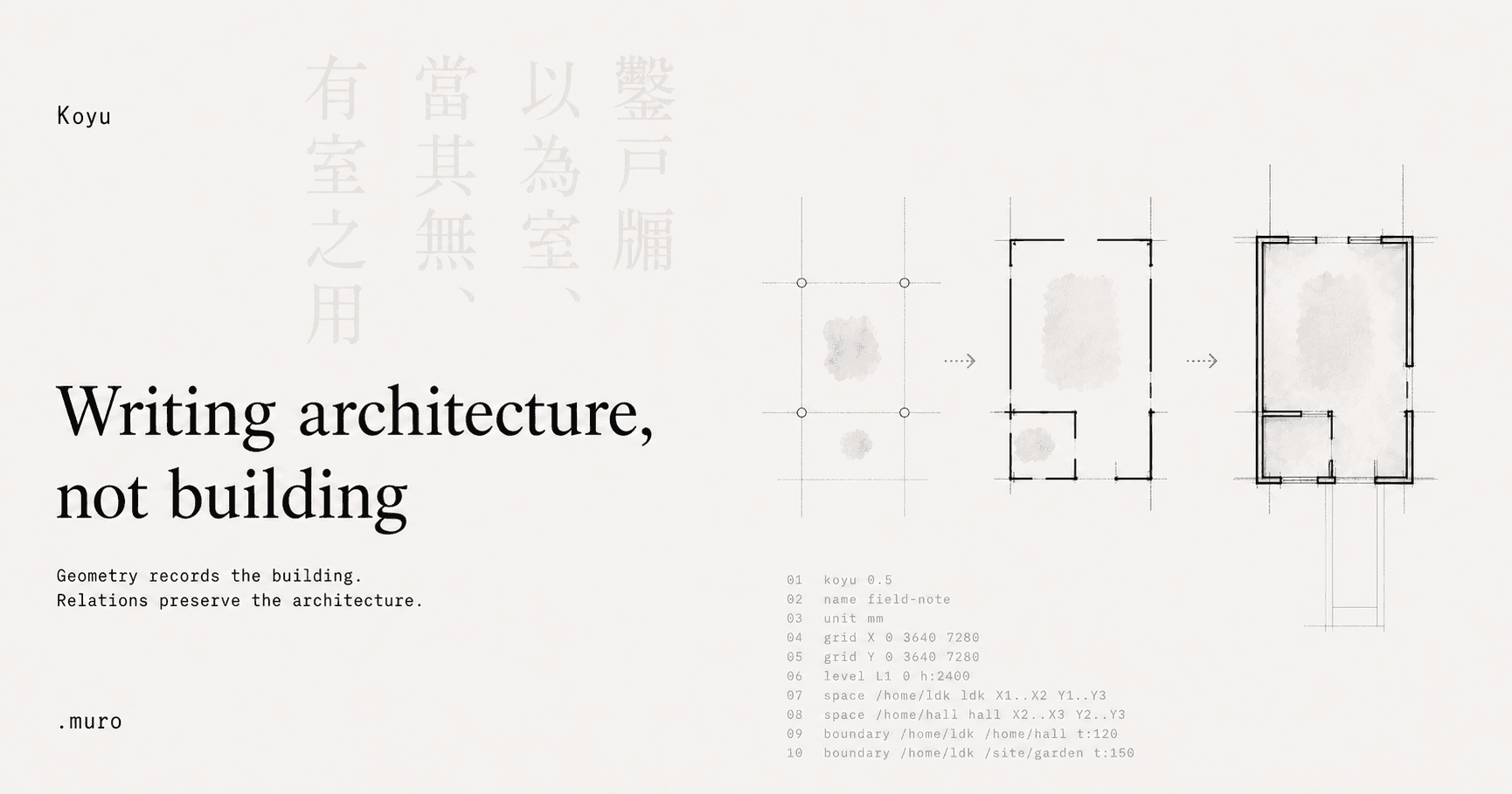
A building is an outcome. Architecture includes the cause.
The distinction is intentionally simple. A building is the physical result we can locate, measure, exchange, and construct. Architecture includes the decisions that organize that result: which activities belong together, what must remain separate, where movement is allowed, and how inside meets outside.
Both matter. The question is which one should be the editable source. If the source begins with the built result, design intent often has to be reconstructed from names, comments, and conventions. Koyu begins one step earlier.
02 / What geometry forgets
A coordinate can locate a wall. It cannot explain it.
A line between two points is precise, but silent about its architectural role. It does not tell us whether the line separates private from public space, protects an acoustic requirement, continues a fire compartment, or is intended to open later.
The geometry says what exists. The architectural source should also say what the relation means.
In conventional workflows, people restore that context through object names, parameters, issue comments, and meeting records. Those are valuable, but they often sit beside the model rather than inside the statement that produced it.
03 / A spatial vocabulary
Begin with space, boundary, adjacency, and passage.
Koyu treats spaces and their relationships as first-class source. A room has an identity and use. A boundary states how two spaces meet. An opening states that passage, view, light, or air can cross that boundary. Levels and references constrain the composition.
space /L1/work office name:shared-studio use:common
boundary /L1/work /L1/court type:open

# The relation is written first.
# Geometry is resolved by the build.
The vocabulary is deliberately small. It should be readable by a designer, reviewable as text, and explicit enough for a build process to derive geometry.
04 / Geometry still matters
Building the shape does not make shape less important.
Construction still requires dimensions, positions, tolerances, and detailed elements. Moving geometry to output is not an argument against precision. It is a separation of roles.
The source records what the architecture is trying to do. The build resolves references, shared edges, openings, and coordinates. Generated geometry can then be inspected, adjusted through explicit constraints, and exported to established building workflows.
IFC remains important in that exchange layer. The experiment is not to erase it, but to ask whether a smaller architectural source can exist before it.
05 / Why this matters now
Language models can work with reasons when reasons are written.
An LLM can compare text, explain a diff, propose a change, and inspect constraints when the relevant context is present. A compact spatial source makes it possible to hold more of a building—and more of its intent—in that context.
The opportunity is not an LLM that draws a surprising image. It is a collaborator that can read the architectural source, discuss the consequences of a change, and produce a revision that remains reviewable by people.